
Navigation überspringen · direkt zum Inhalt
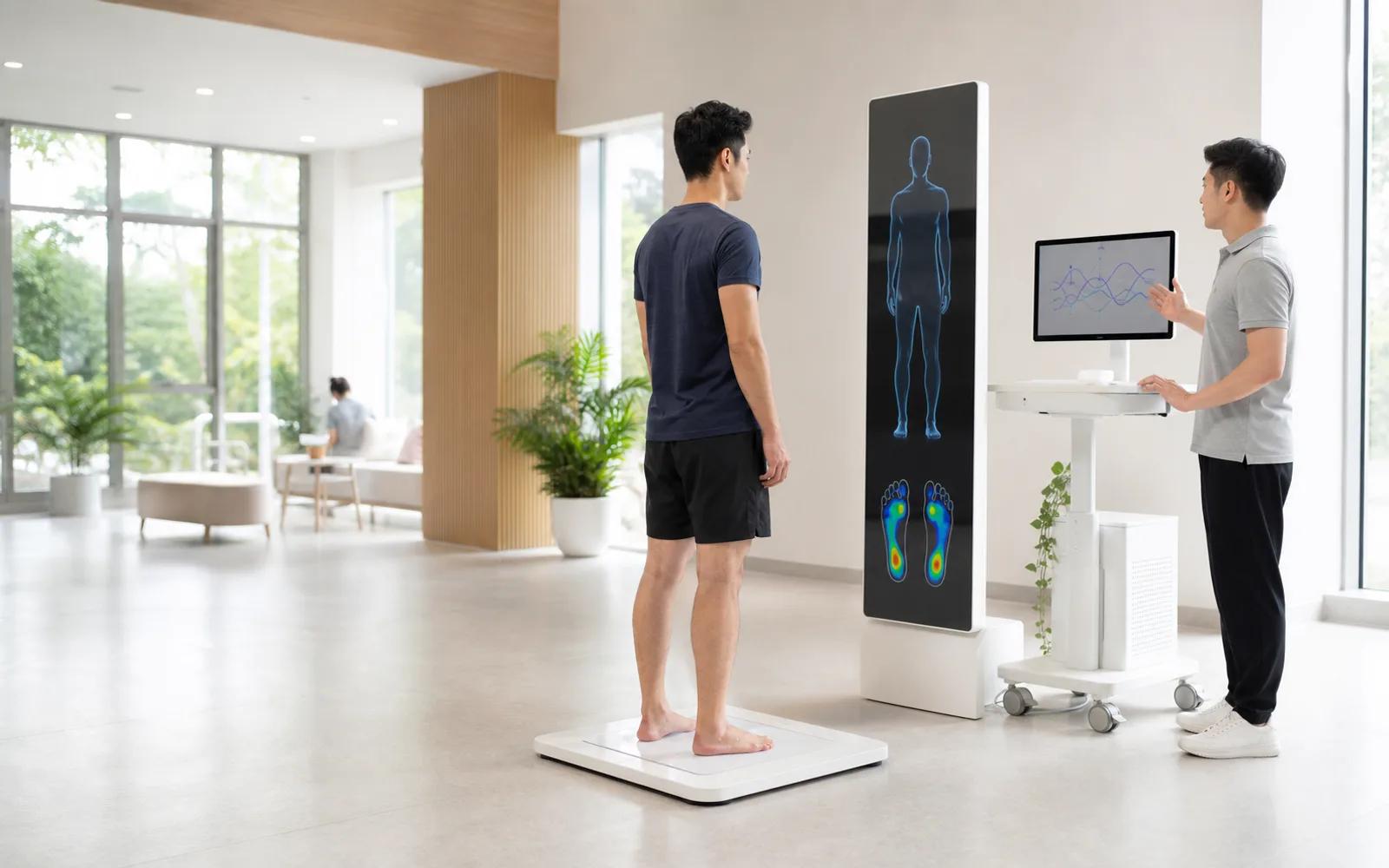
A bright corner of a movement-health station: a person stands barefoot on a white plantar-pressure plate beside a vertical display showing a posture outline and a foot-pressure heatmap, while a health consultant reviews the assessment curve at a cart workstation
BAYES

BAYES · Motion-Health Service Solution

A 70-second screening that the rest of the loop can build on

Bayes serves three settings — community hospitals, rehabilitation departments, and portable field screening. Plantar-pressure and gait data turn "looks about right" into an objective record; the result carries an exercise recommendation, orthotic fitting and an at-home routine; and a later re-screen on the same metrics makes the change visible.

The device produces data, the report produces guidance, the mini-program produces adherence, and the re-screen produces comparison — four stages that form one loop rather than four unrelated things.

01 / WHERE IT RUNS

Four screening settings, one pressure plate at the centre of the walkway

The programme splits into three stages — screen, assess, intervene. The screening stage happens in four settings: community hospitals, community health huts, street clinics and school health checks. The device at the centre is the same distributed pressure-array plate in every one of them, flanked by walkway boards or mats with foot-position guides; what changes is the venue and the population, not the metric set. That is what makes the loop possible.

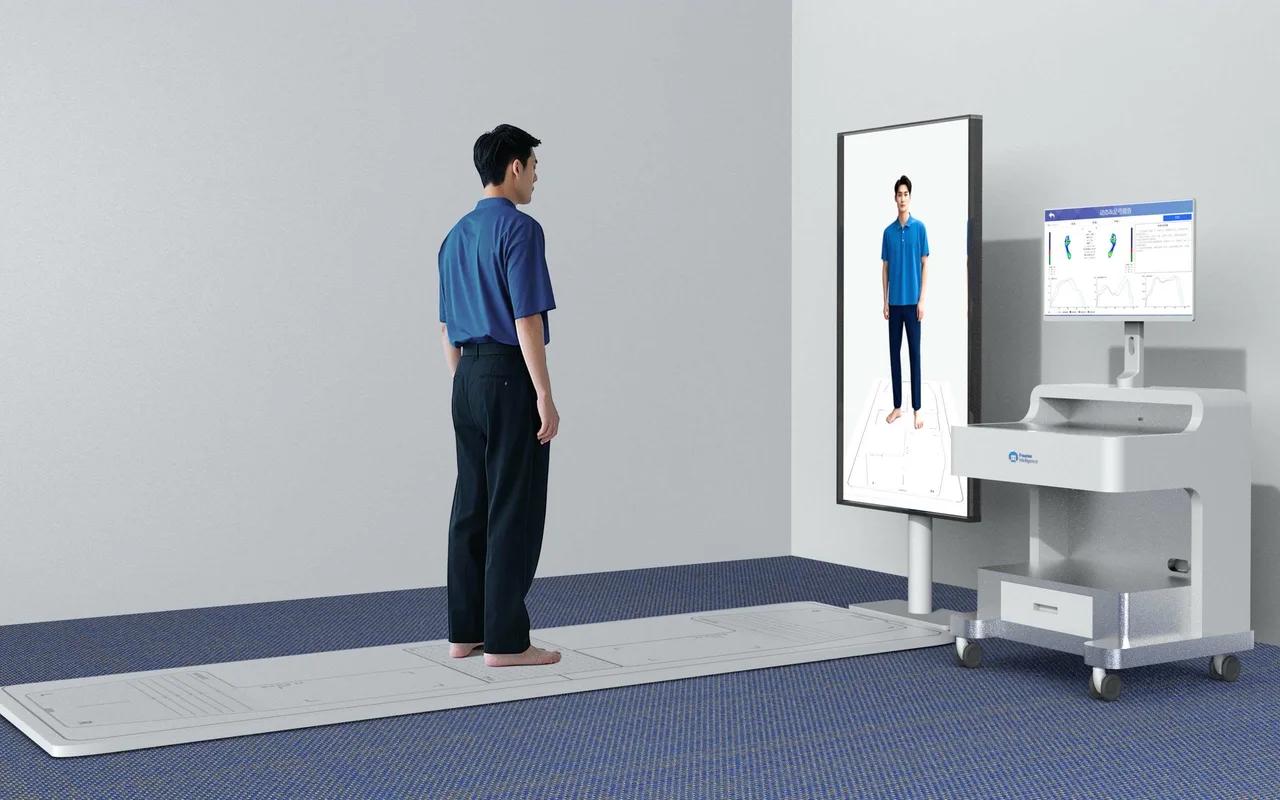
A community hospital assessment room (device rendering): a person stands barefoot on the pressure plate in the middle of the walkway, flanked by wooden walkway boards with foot-position guides, facing a vertical display showing a posture outline and a foot-pressure map, with a white cart workstation and monitor to the right

Setting 01

Community hospital

Who uses it

General practice and rehabilitation physicians, public-health teams, family-doctor services

The problem right now

A consultation lasts ten minutes, so foot, posture and balance problems get judged by eye. Without data there is nothing to explain, nothing to file and nothing to compare against next time.

Device on site

PelmaMotus Pro™ Intelligent Motion-Function Assessment

A distributed pressure-array system at 4 points/cm², sampling up to 200 Hz with 16-bit AD, calibrated in real time by high-precision force sensors. Combined with a biomechanics and rehabilitation-assessment knowledge base, it captures standing posture and gait quickly and precisely. The source document lists it for rehabilitation, health-check, orthopaedic, paediatric-care and endocrinology departments.

Marked on the image

  • Pressure plateThe pressure plate sits in the middle of the walkway, flanked by wooden walkway boards with foot-position guides. Stand on it or walk across it and static and dynamic plantar pressure are captured in one pass; the boards are sized to the room — no building work, no dedicated space.

One screening produces

  • Gait assessment
  • Plantar pressure
  • Balance assessment
  • Posture assessment

What it means for the site

It replaces "looks about right" with a result that can be filed, repeated and compared. Two services already carry billing codes in China — 340200007 gait analysis and 340200002 instrumented balance assessment — so a department has a basis to run them.
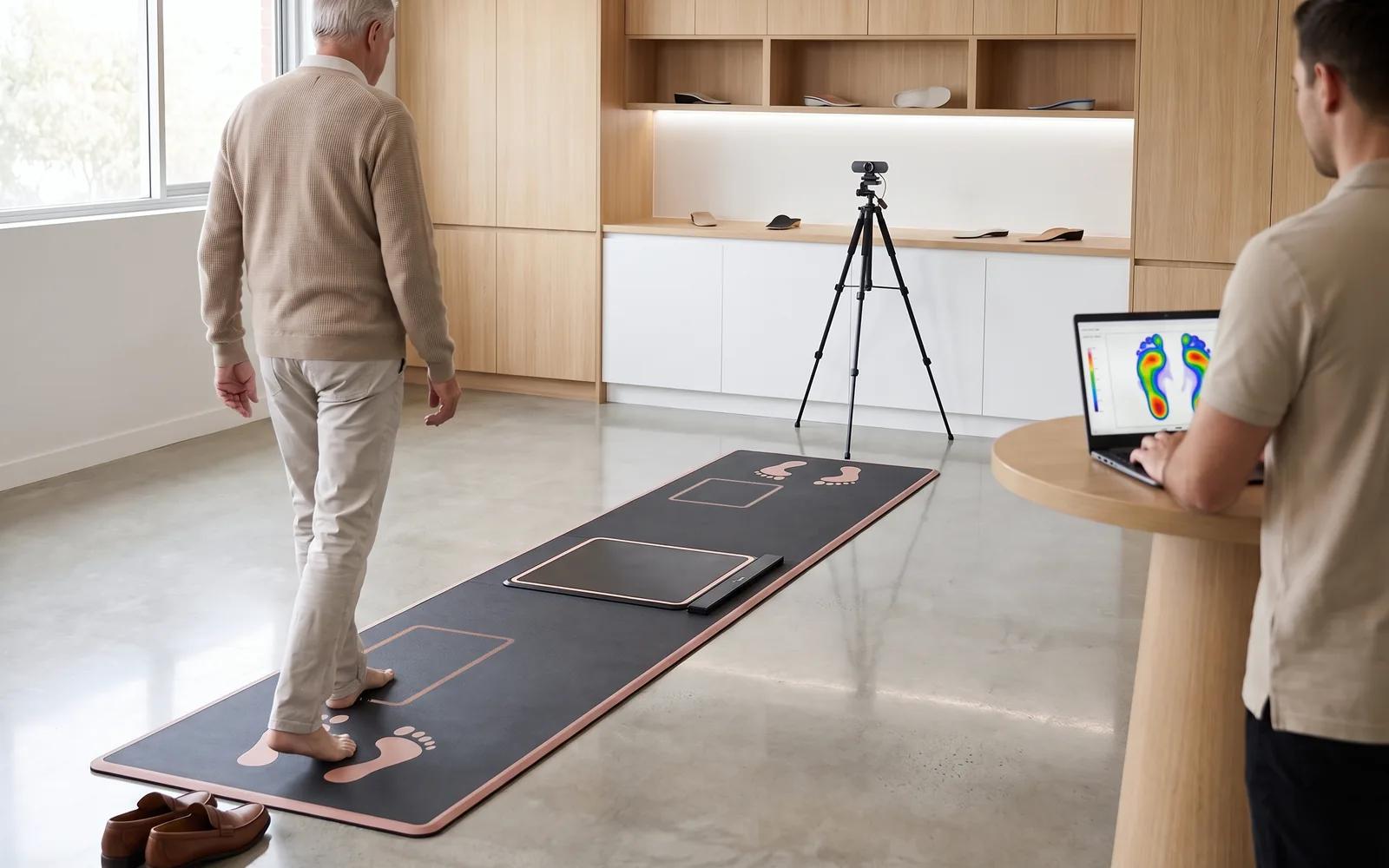
Community health hut (illustrative scene): custom insole samples on wooden shelves, a dark walkway mat with foot-position guides laid across the floor with the pressure plate in the middle; a resident walks barefoot along it while a health advisor reviews the foot-pressure map on a laptop at a round table, with a tripod camera at the far end of the walkway facing back along it

Setting 02

Community health hut

Who uses it

Community health huts, chronic-disease management, family-doctor teams

The problem right now

A health hut measures blood pressure, blood glucose and body composition — but not motion function. The back, legs and feet residents complain about most are the one thing nothing there can quantify.

Device on site

PelmaMotus™ Lite Intelligent Motion-Function Assessment (portable)

A portable screening system on the same distributed pressure array, paired with the biomechanics and rehabilitation-assessment knowledge base and AI analysis. The source document lists it for sports-rehabilitation clinics, community rehabilitation centres, health huts, fitness clubs and footwear retail.

Marked on the image

  • Pressure plateThe pressure plate sits in the middle, with foot-position guides printed on the walkway mats either side. Rolled out on the open floor it becomes the test position, sharing the room with the insole display and the assessment station. No separate room required.

One screening produces

  • Gait assessment
  • Plantar pressure
  • 70 seconds
  • QR code into the mini-program

What it means for the site

It turns a blood-pressure-and-leave visit into a motion-health record worth following. The result leads straight into custom health insoles, so the hut becomes a service point rather than just a screening point.

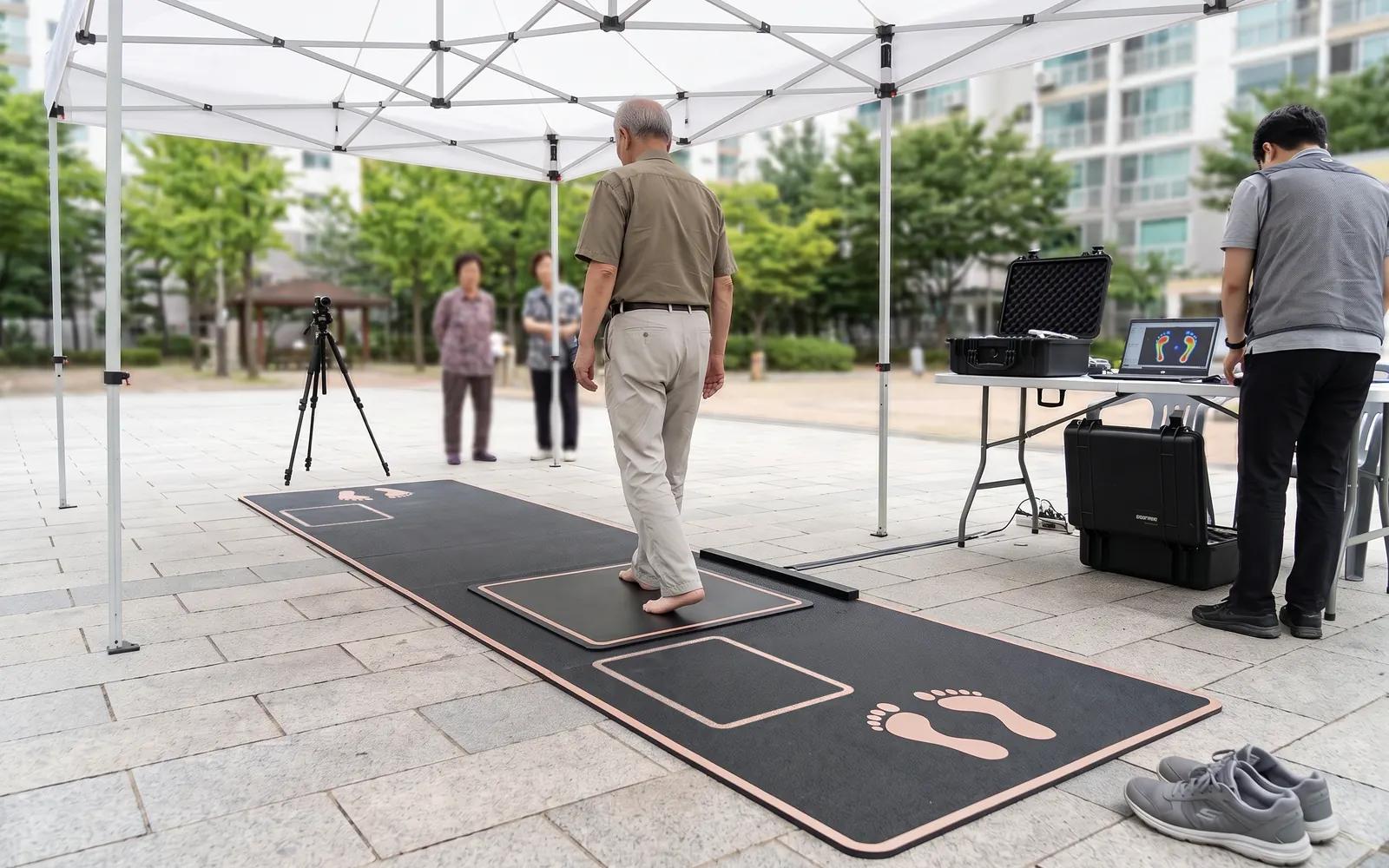
Street clinic (illustrative scene): under a white canopy, a walkway mat with foot-position guides is laid on the paving with the pressure plate in the middle; a resident steps barefoot onto the plate while others wait beyond the walkway, a staff member reviews the foot-pressure map on a laptop at a folding table beside equipment cases, and a tripod camera stands at the far end of the walkway facing back along it

Setting 03

Street clinic

Who uses it

Neighbourhood outreach clinics, family-doctor field services, corporate health programmes

The problem right now

An outreach table has no room for an assessment system, yet the people who most need early screening are the ones standing at it. Equipment you cannot carry is people you cannot screen.

Device on site

PelmaMotus™ Lite Intelligent Motion-Function Assessment (portable)

The whole set packs into a case and wheels away, then rolls out on site. A three-step guided flow covers both assessments in 70 seconds, at roughly 200 people per day, across every age group and occupation.

Marked on the image

  • Pressure plateThe pressure plate and its flanking walkway mats lay straight onto outdoor paving under the canopy. Foot-position guides on the mats let residents find their own way across, and a QR code at the end carries the result into the mini-program, so the lead does not end when the session does.

One screening produces

  • Standing posture and balance
  • Single-leg gait / arch
  • Result and guidance on site
  • QR code into the mini-program

What it means for the site

It turns an outreach session from a one-off measurement into a record worth following up. Without this step there is nothing for the re-screen to compare against.

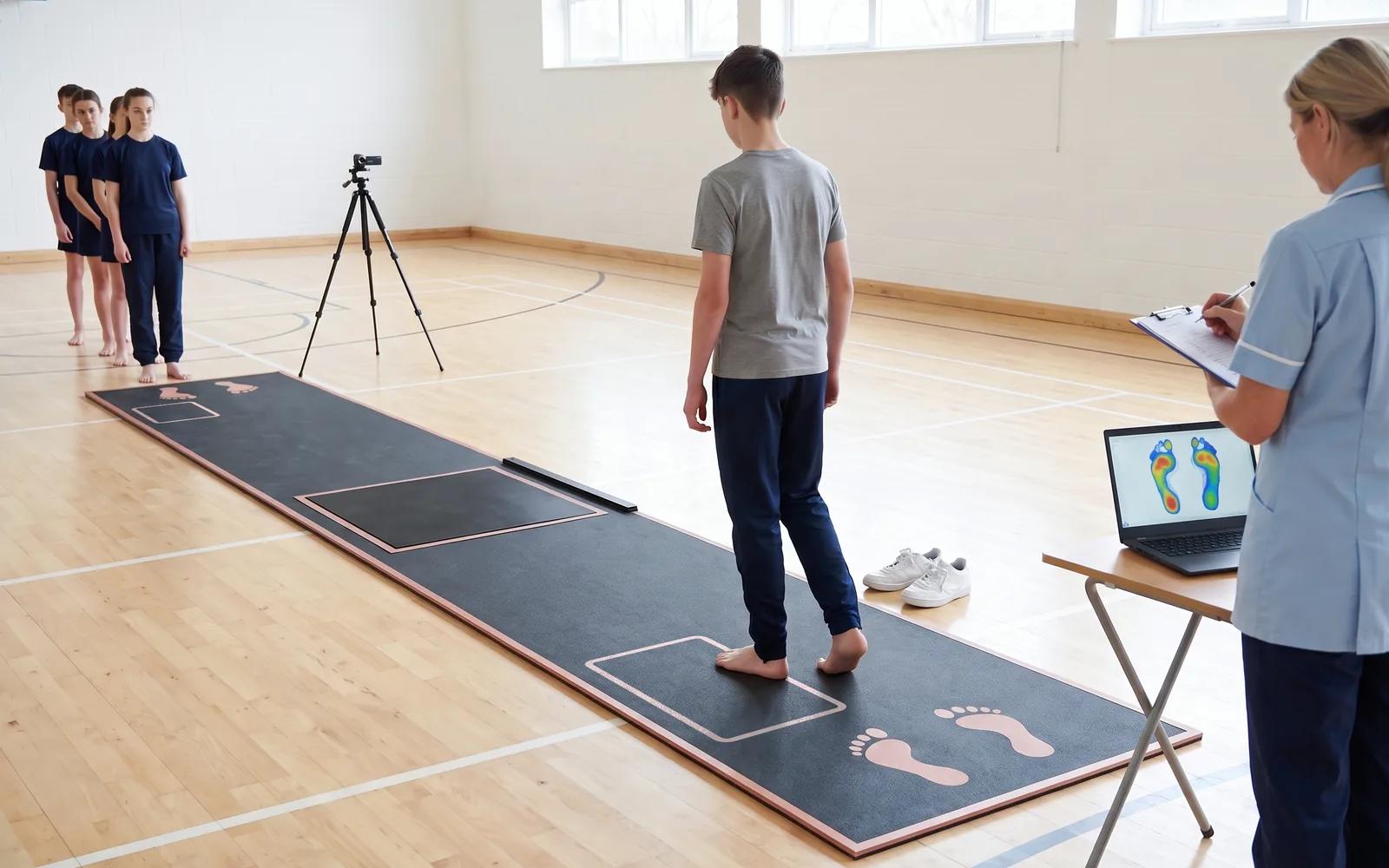
School health check (illustrative scene): in a gymnasium, a walkway mat with foot-position guides lies on the wooden floor with the pressure plate in the middle; a student stands barefoot at the start of the walkway, about to walk towards the plate, while others queue near the far end and a school nurse takes notes on a clipboard beside a laptop, with a tripod camera at the far end facing back along the walkway

Setting 04

School health check

Who uses it

School clinics, student fitness screening, paediatric care

The problem right now

Scoliosis, flat foot and in/out-toeing are all easier to correct the earlier they are found — and a standard school health check contains nothing that looks at the feet or posture.

Device on site

PelmaMotus™ Lite Intelligent Motion-Function Assessment (portable)

Volume screening runs as a queue: one device, one walkway, each student walks through and the capture is done. The source document lists children aged 3–7 and adolescents among the intended groups.

Marked on the image

  • Pressure plate with guided matsFoot-position and direction guides are printed on the walkway mats either side of the plate, so students place themselves correctly without being guided — which saves a great deal of staff time at volume.

One screening produces

  • Posture (neck / spine and pelvis / lower limb)
  • Plantar pressure (arch index and more)
  • Gait assessment
  • Tiered intervention guidance

What it means for the site

One check covers foot, ankle, knee, hip, pelvis, lower back, neck and shoulder together. Anything abnormal is routed by tier — orthopaedic surgery, conservative rehabilitation care, orthotic intervention with health insoles, or a daily training course.

02 / WHAT ONE SCREENING GIVES YOU

One screening, three deliverables

The value of a device is not how much it measures but whether the clinician can use the output directly. Bayes splits one screening into data, guidance and judgement.

  • Data · quantify the state first

    Static and dynamic plantar-pressure testing produces quantified standing posture, balance and single-leg gait / arch results. The onboard compute unit uploads to and pulls from the cloud, archiving and pushing data at a scale that supports research analysis.

  • Guidance · a recommendation matched to the finding

    A biomechanics and rehabilitation-assessment knowledge base, combined with AI analysis over large datasets, turns the finding into a matching exercise-rehabilitation recommendation — something a person can actually follow, not just a chart.

  • Judgement · handed to the clinician

    Result and recommendation appear together, so the clinician decides between on-site guidance, mini-program follow-up, or referral to a department. The device assists the judgement; the judgement stays with the clinician.

Assessment results and exercise recommendations are for motion-function screening and health management. They do not replace clinical diagnosis; referral and treatment decisions remain with the clinician.

03 / THE CLOSED LOOP

Screen → report → intervene → re-screen → compare, then round again

A single screening answers "where are you now". Only a loop answers "did it get better". The five steps are held together by one metric set: control the conditions and the results become comparable.

One metric set · comparable over time

What makes the loop work is not more equipment. It is that every round uses the same device, the same metrics and the same test conditions.

  1. Screen

    70 seconds · two assessments

    Standing posture and balance plus single-leg gait, through a three-step guided flow the person can follow unaided. The result is filed immediately as this round's baseline.

  2. Report

    Data plus matching guidance

    The quantified result arrives with its exercise-rehabilitation recommendation, so the clinician can choose on-site guidance, home follow-up, or referral.

  3. Intervene

    Orthotic fitting plus at-home check-ins

    Orthotic fitting is specified from the pressure and gait data. In parallel, a QR code opens the mini-program, where exercise videos and tutorial articles guide daily training, prevention and correction.

  4. Re-screen

    Measure again on the same metrics

    After an interval the person returns to the same device. Test conditions and metric definitions match the first round — the one precondition for data that can actually be compared.

  5. Compare

    The change becomes visible

    The two datasets sit side by side: what improved, by how much, and what has not moved yet. It goes into the record and into the conversation — then the next round begins.

Begin the next round

Orthotic fitting and mini-program content are delivered by Aili Intelligence together with its partners; the exact service scope and re-screening interval are confirmed commercially.

04 / THE PART THAT HAPPENS AT HOME

The at-home stretch belongs to the exercise-prescription agent

Screening happens on site; training happens at home. The mini-program turns the assessment into a schedule someone can follow: which video, which movement, for how many days, and when to come back.

  • Exercise videos

    Training videos for the relevant area are pushed based on the assessment. People follow along — they should not have to read a report before they know what to practise.

  • Tutorial articles

    Arch, posture and balance explained plainly, so people know what they are changing and why. Understanding is what makes them keep going.

  • Check-ins and recall

    Daily check-ins build an adherence record, and a reminder brings people back for the re-screen — turning one screening into long-term health management rather than a report that gets filed away.

What the agent runs on

  • Multimodal motion-behaviour data
  • Health-industry knowledge base
  • Mini-program intelligent services

Mini-program content and push strategy vary with the assessment result; the shipped version is authoritative.

05 / DEVICES

Two devices, chosen by setting

The Bayes health line is two devices today, both on one technical line — a distributed pressure array with real-time calibration from high-precision force sensors — in different formats and scales for different settings. Rehabilitation-line equipment is outside the scope of this solution.

DeviceModelTest areaSensor countArray densityPrimary setting
PelmaMotus™ ProAL-600-G1400 × 600 mm9,6004 points/cm²Community hospital · station / rehabilitation
PelmaMotus™ LiteAL-300-G1360 × 520 mm2,400> 1 point/cm²Portable field screening

PelmaMotus™ Pro samples at up to 200 Hz with 16-bit AD, with four high-precision single-axis force sensors calibrating in real time (national invention patent granted), and takes an optional balance-training module; the PelmaMotus™ Lite test area is about 2.5 mm thick and rolls up to carry. Full specifications and options are on each product page.

06 / GET STARTED

Pick one setting and close the loop there first

There is no need to open all three settings at once. Tell us the setting, the daily volume and the space you have, and we will come back with a device configuration, a sample report, and a re-screening path that can actually demonstrate change.

  1. 01Setting and daily volume
  2. 02Device configuration and space requirements
  3. 03Sample report and re-screening interval
  4. 04Orthotic and mini-program integration